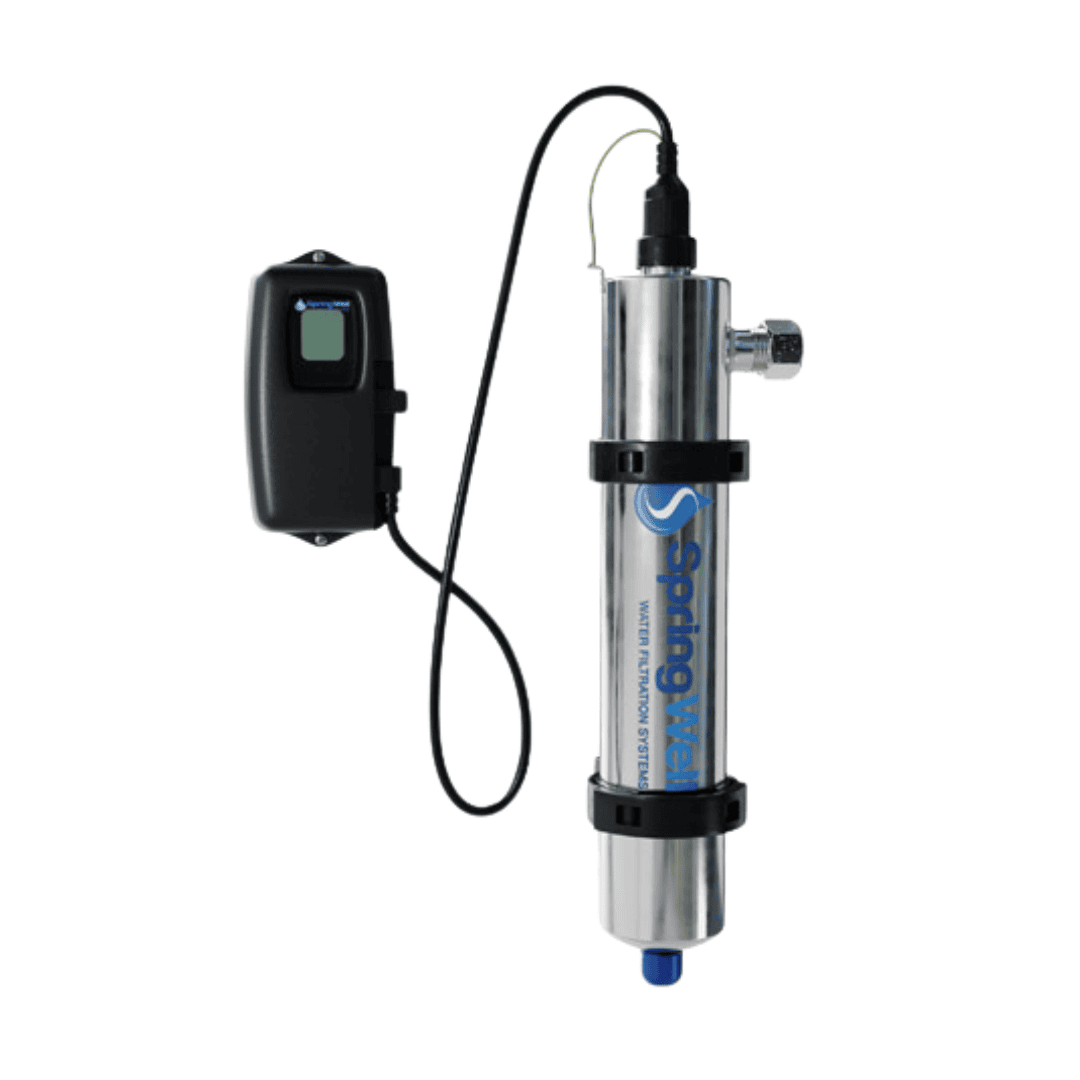
If your well water has tested positive for coliform bacteria or you’re simply seeking ways to ensure the safety of your household from its source, the same advice has likely come up: install a UV light for well water.
Ultraviolet disinfection is one of the go-to fixes recommended by well contractors and state health departments, for good reason: ultraviolet disinfection kills bacteria and viruses without adding chemicals to your water, but unfortunately many homeowners misunderstand this treatment and purchase either an incorrect size UV light for well water unit, fail to add an essential pre-filter element, or assume more from it than it actually offers.
This guide provides an in-depth explanation of UV light for well water, their purpose and application as well as costs of uv light for well water and how you can determine if UV illumination is suitable in your situation.
What Is UV Light for Well Water?
UV light for well water system are disinfection devices installed directly onto your main water line, usually after your pressure tank. As water flows through it passes a UV-C lamp housed inside a protective quartz sleeve containing protective quartz coating, which disrupts bacteria, viruses and protozoa so they no longer reproduce and cause illness to others.
UV light for well water is a chemical-free disinfection method that relies on ultraviolet radiation to eliminate microorganisms as the water enters your home, neutralizing harmful microbes as it arrives but it won’t remove sediment, minerals, or chemicals itself.
UV treatment differs from chlorination in that it leaves no taste, odor, or residue behind; its physical nature makes it appealing to homeowners. But that also means it only works well under the right conditions — more on that shortly.
Why UV Disinfection Matters for Well Owners
Many new well owners don’t realize this: private wells aren’t subject to the same regulation by the EPA as municipal water systems are; that means it is solely up to you, as an owner, to test and treat their well water according to Safe Drinking Water Act regulations.
Responsibility is of utmost importance because coliform bacteria — found in human and animal waste, soil and plant matter — can contaminate private wells with E. coli strains that are truly dangerous for health reasons. Contamination doesn’t always come with warning; sometimes water may appear clear and taste normal while harboring bacteria that could make your family sick.
UV disinfection has become an industry standard following positive well water test results, for newly drilled wells or any household using shallow wells near septic systems, livestock or farmland.
Who Actually Needs a UV System
UV isn’t necessary for every well owner, but it’s strongly recommended in several common scenarios:
- You’ve had a positive coliform or E. coli test. This is the single most common reason people search for UV systems in the first place.
- You have a new or recently drilled well. New wells frequently show bacterial activity before they’re fully disinfected and retested.
- Your well is shallow or dug rather than deep and drilled. Shallow wells are particularly susceptible to surface contamination.
- They’re often in close proximity to a septic system, farmland, livestock and runoff or seepage sources of pollution; and have someone living within your household who is immunocompromised, young or elderly that needs extra protection against pathogens – making extra precautions a wise decision.
Depending on where your home is connected to the public water source, disinfection steps such as chlorination may not be required; as municipal water has already undergone all required treatments prior to reaching your tap.
When UV Works Well (and When It Doesn’t)
This is the part most product pages gloss over, and it’s the part that actually determines whether your system will work.
UV performs well when:
- Your water is already clear, with low turbidity
- The concern is biological — bacteria, viruses, or protozoa
- You have reliable, consistent electricity
- Flow through the system stays within its rated capacity
UV struggles, or needs help, when:
- Water is cloudy or has visible sediment, which blocks UV rays from reaching organisms
- Iron, manganese, or tannins are present — they coat the quartz sleeve and reduce UV penetration
- Water is very hard, since scale buildup gradually cuts down UV output
- The issue is chemical, not biological — UV does nothing for nitrates, arsenic, lead, or PFAS
- There’s no dependable power source
Warning: A still glowing UV light for well water bulb does not necessarily indicate its efficacy; UV-C output often decreases long before visible light fades, prompting manufacturers to recommend replacing bulbs regardless of appearance every year.
Due to all these reasons, UV light for well water should almost never be used as an independent solution; rather it should form part of a comprehensive water treatment setup with sediment filtration and iron removal or softening capabilities as necessary.
3 Best UV Light For Well Water
1. Viqua VH410
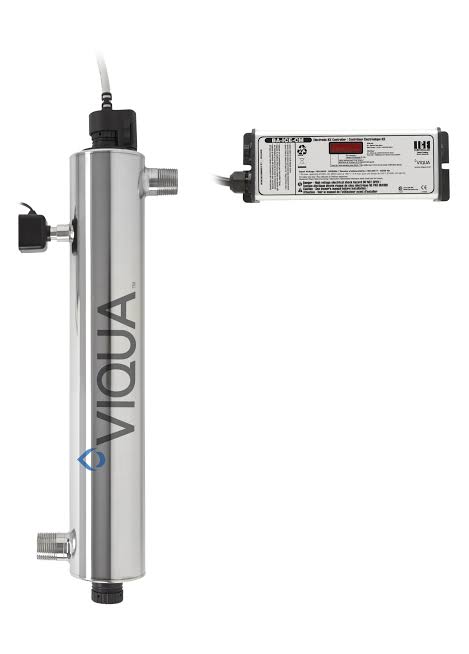
Viqua VH410 is the system most well contractors reach for by default, and it’s the safest bet if you want proven, industry-standard performance. It’s NSF/ANSI 55 Class A certified, meaning it delivers the full 40 mJ/cm² dose required for genuine bacteria and virus disinfection, and it’s rated up to roughly 14–18 GPM depending on the dose standard used, which comfortably covers a 3–4 bathroom home with several fixtures running at once.
The stainless steel chamber and simple digital controller — showing remaining lamp life plus an audible alarm on failure — make it easy to monitor without guesswork. The one catch is that Viqua strongly recommends a sediment pre-filter ahead of it, which isn’t included, so factor that into your budget. Expect to pay around $900–$1,100 for the unit itself.
2. Aquasana Rhino Well Water with UV
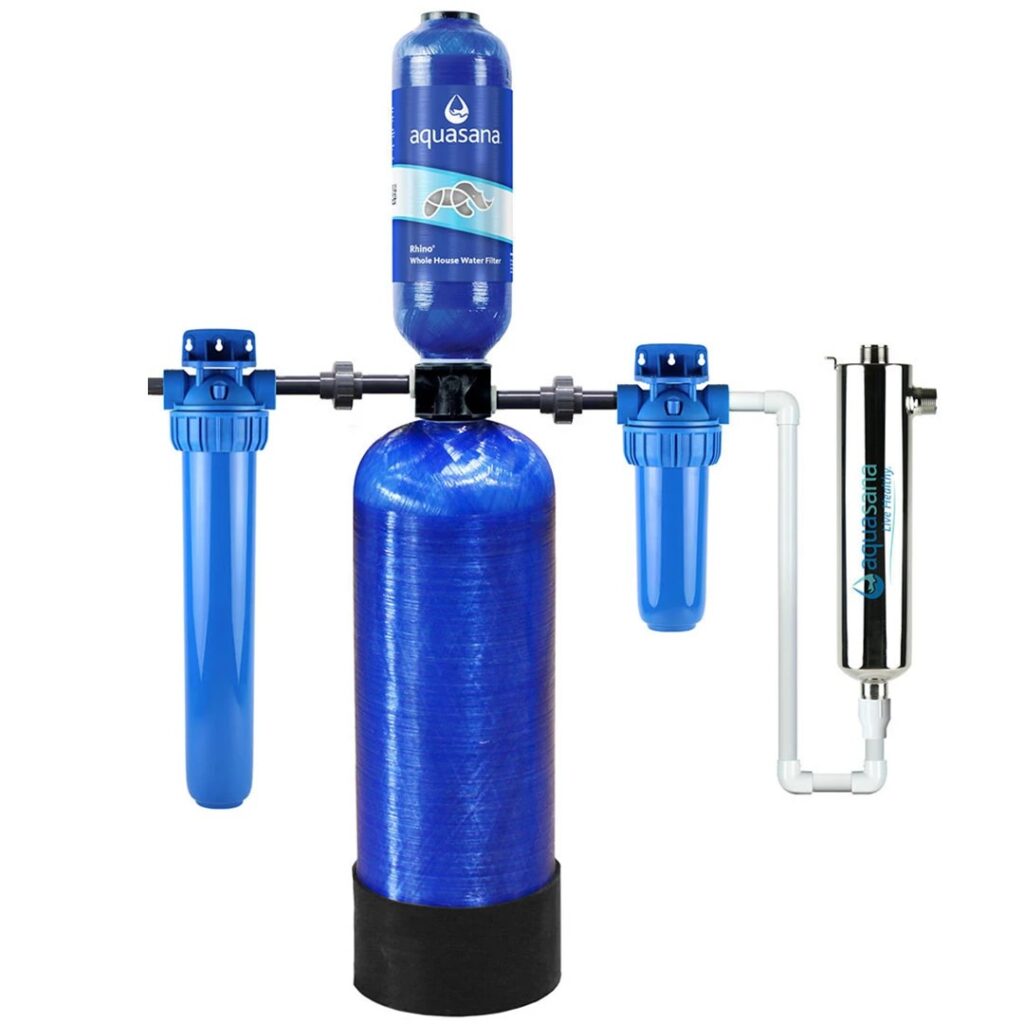
Aquasana Rhino Well Water with UV is the ideal system for any household that wants a comprehensive approach to disinfection of well water. This unit combines whole-house sediment and carbon filtration, as well as an UV stage designed specifically for well conditions, sterilizing up to 99.8% of bacteria and nonpathogenic viruses. Because pre-filtration is already built in, you skip one of the most common installation mistakes — putting UV first instead of last in the treatment line.
It also runs on about the same power draw as a standard light bulb, so operating costs stay low. This is the right pick if your well water has sediment, chlorine taste, or odor issues on top of a bacteria concern. It typically runs $900–$1,400 for the full whole-house system.
3. iSpring UVF55F
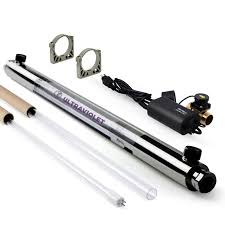
iSpring UVF55FS is the value option, and it has one genuinely useful feature the others lack: a smart flow-sensor switch that only runs the lamp when water is actually flowing, instead of burning it 24/7. That extends bulb life and cuts electricity use without sacrificing disinfection when it matters. It’s built around a 304 stainless steel reactor chamber with a 1-inch NPT inlet and outlet, rated at 12 GPM — enough to handle two showers running simultaneously in a typical family home.
It’s a strong pick if you already have sediment and iron pre-treatment in place and just need a reliable UV stage to finish the job, and it costs noticeably less than the other two, usually $400–$550. One thing to do before buying any of these: get your well water tested for turbidity, iron, and hardness first, since that determines whether you need the standalone units or the all-in-one Aquasana setup.
UV vs. Other Well Water Treatment Options
UV light for well water is rarely a homeowner’s only treatment step — it typically works alongside other equipment. Here’s how it stacks up:
| Method | Kills Bacteria/Viruses | Removes Chemicals | Needs Power | Ongoing Cost |
| UV Light | Yes (Class A) | No | Yes, continuously | Annual bulb replacement |
| Chlorination | Yes | Some | Minimal | Chemical refills |
| Reverse Osmosis | Partial (usually point-of-use) | Yes, extensive | Minimal | Membrane replacement |
| Water Softener | No | Removes hardness only | Minimal | Salt refills |
| Sediment/Carbon Filter | No | Chlorine, taste, odor, sediment | None | Filter changes |
The biggest advantage UV light for well water has over chlorination is that it doesn’t alter taste or add chemical byproducts. The biggest advantage chlorination has over UV is that it keeps working during a power outage — UV light for well water provides zero protection the moment the power goes out, with no residual effect afterward.
Installing a UV System: What to Expect
While hiring a licensed well or plumbing contractor is strongly recommended for correct sizing and code compliance, here’s the general process:
- Test your water first — confirm turbidity, iron, and hardness levels before buying anything.
- Install pre-treatment ahead of the UV unit — sediment filtration, and iron removal or softening if your test calls for it.
- Choose the installation point, typically right after the pressure tank, somewhere protected from freezing.
- Mount the reactor chamber according to manufacturer instructions.
- Add shut-off and bypass valves so future maintenance doesn’t require cutting water to the whole house.
- Connect to a dedicated, always-on power source — UV systems run continuously, 24/7.
- Before first use, be sure to flush the system thoroughly to clear away installation debris
- Test your water for bacteria levels post installation.
- Set an alert every nine to 12 months to remind yourself to replace bulbs.
Homeowners Often Make Mistakes
- Buying a UV light for well water system before testing their water
- Undersizing the unit for their home’s actual peak flow rate
- Ignoring the annual bulb replacement schedule
- Installing UV before sediment or iron filtration instead of after
- Assuming UV handles chemical contaminants like nitrates or arsenic
- Skipping the bypass valve, making maintenance a hassle later
- Never retesting water after installation to confirm it worked
FAQs About UV Light For Well Water
Q: Do UV light for well water really purify well water?
Yes – NSF/ANSI 55 Class A systems have been shown to inactivate up to 99.99% of bacteria and viruses found in clear water sources while simultaneously helping remove sediment, minerals, or chemical contaminants – however these measures only partially address concerns so often need additional filtration measures for best results.
Q: Can UV light for well water remove iron and sulfur odor from well water?
No. UV light for well water only targets microorganisms; for any iron, manganese, and sulfur-related odors to be properly addressed with separate filtration equipment installed before installing UV.
Conclusion: UV Light For Well Water
UV lights for well water are one of the most reliable chemical-free ways to keep household tap water safe from bacteria and virus contamination, yet it only works as effectively as its system surrounding it. Before installing UV, test your water, pair UV light for well water with appropriate pre-treatments such as chloramine-based ones and verify genuine NSF/ANSI 55 Class A certification before having it professionally sized and installed – after this, the UV light for well water system should run quietly in the background without altering how your tap water tastes or smells over time.
These information are gathered from different surveys, medical tests and tech giants like google, wikipedia and more. Our top priority is to provide you valuable information.
For More Details About Different Water Filters Click Here