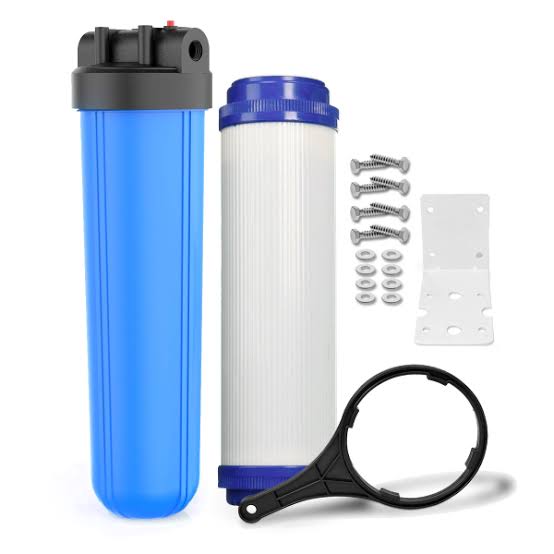
once alarmed, and confused about what to actually do next. That confusion is widespread and not your fault — almost all widely read advice out there is either incorrect or incomplete. For the short answer: a regular pitcher filter will not cut it. Boiling won’t help you. Even one of those water softeners, would be just the tool for the job — however it doesn’t touch nitrates. There is a special nitrate water filter for nitrate removal in the drinking water, and you need to know what nitrate water filter properly suits your needs otherwise you may be wasting valuable money instead of getting healthy nitrate water filter protection for your family.
What Nitrates Are, And Why They Get into Your Water
Nitrate (NO₃⁻) is a naturally occurring compound comprised of nitrogen and oxygen. There are small background levels nearly everywhere, but higher concentrations are an artificial problem caused mainly by agriculture.
Common sources are:
- Runoff from fertilizer and agricultural practices seep into the ground water
- Feedlot and livestock waste
- Failing or aging septic systems
- Natural soil decomposition, in smaller amounts
Nitrate is colorless, odorless and tasteless. You can’t honestly sense it: you can only find out that it’s there by testing.
The Three Technologies That Actually Remove Nitrate
1. Reverse Osmosis (RO) Water
Squeezed through a very small, semi-permeable membrane to particles and dissolved ions such as nitrate.te. While there are many systems out there that address those other contaminants efficiently, most home RO systems will reject 85–95% of nitrate. This is the most prevalent point-of-use solution — normally located underneath a kitchen sink.
2. Ion Exchange (Nitrate Selective Anion Resin)
This uses a specialized resin — typically Type II strong-base anion resin which exchanges chloride ions for nitrate ions as water passes through. It’s regenerated periodically with a salt brine, similar to how a softener recharges. Removal rates typically reach 90–98%, and because it can be installed at the main water line, it’s the better option for whole-house treatment rather than just drinking water.
3. Distillation
Water is boiled into steam and condensed back into liquid, leaving nitrate (and almost everything else) behind. It’s highly effective — up to 99% removal — but slow, energy-intensive, and impractical for anything beyond a few gallons a day.
| Feature | Reverse Osmosis | Ion Exchange |
| Nitrate removal | 85–95% | 90–98% |
| Best for | Drinking/cooking water | Whole-house treatment |
| Typical cost | $150–$400 | $800–$2,500+ |
| Maintenance | Filter changes every 6–12 months | Salt refills every 4–8 weeks |
| Removes other contaminants | Yes (broad) | Mostly nitrate-focused |
If you only need safe drinking and cooking water, RO is usually the more affordable, faster path. A whole-house ion exchange system is worth the higher up front costs, so long as nitrate isn’t just affecting the water at every tap in the house — and particularly if you draw from a well where readings are consistently high.
A technical detail you should know is that nitrate-selective resin would lose some effectiveness in sulfate-rich waters as they are both attracted to the same binding sites. If you have an elevated sulfate level in addition to nitrate, be sure to alert whoever advises you on your sizing.
3 Best Nitrate Water Filter Models
1. Express Water IROSDX Reverse Osmosis System
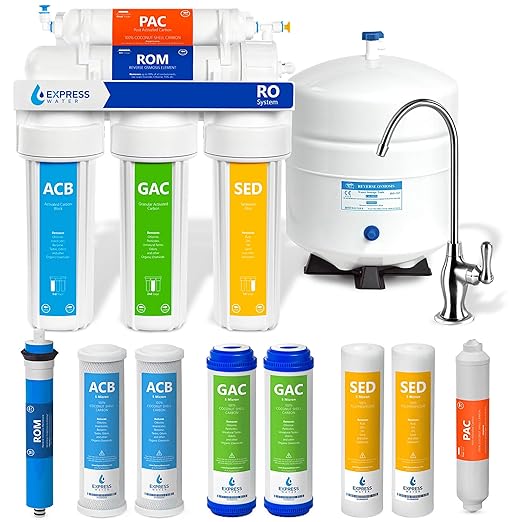
One of the best purchased options for eliminating nitrates in drinking water is the Express Water IROSDX Reverse Osmosis System. It features a state of the art 5-stage reverse osmosis filtration system designed to reduce up to 99% of nitrates plus lead, arsenic, fluoride, chlorine and total dissolved solids (TDS).
This system produces a whopping 50 gallons of purified water each day, easily adequate for the largest units. It also has a leak detection system that detects leaks and shuts off the mains water supply to stop potential damage caused by leaking water in your home.
2. Waterdrop G3 Reverse Osmosis System
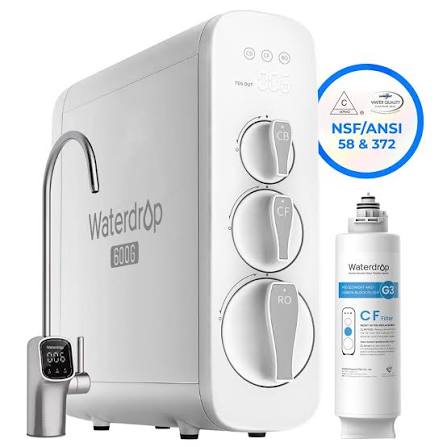
The Waterdrop G3 Reverse Osmosis System is a tankless water filter that balances high capacity with a small footprint. It removes as much as 99%+ of nitrates and also heavy metals, fluorides, chlorine along with other harmful contaminants.
The G3 also has a tankless design which makes it more space-efficient under the sink compared to conventional RO systems and it provides a fast flow of water Near the bottom is a smart LED tap that gives instant information on water quality and filter life, allowing homes to do maintenance with ease.
3. APEC ROES-50 Reverse Osmosis System
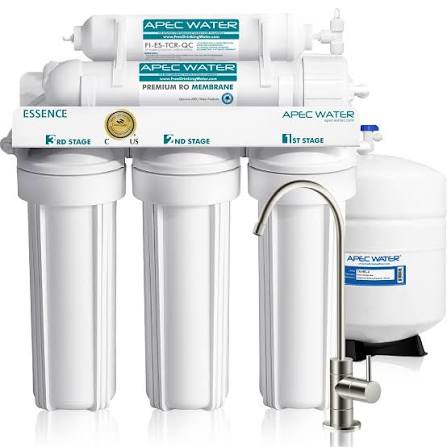
APEC ROES-50 Reverse Osmosis System APEC has been providing reliable, low-cost products for over 20 years with the goal of making homes and businesses safe and healthy. Equipped with a 5-stage reverse osmosis process, it removes up to 99% of nitrates, lead, arsenic, chlorine and bacteria along with several other dissolved impurities.
The ROES-50 is designed to last with high quality components, great reliability, and filters that last a long time. The system is incredibly simple to maintain and has gained a solid reputation amongst homeowners for providing clean, great tasting drinking water at an affordable price.
How to Test Your Water for Nitrate
- Don’t guess — test. Options range from quick and rough to slow and precise:
- Home test strips — Fast (under 5 minutes), inexpensive, moderate accuracy. Good for a first check.
- Digital colorimeter — More precise, still DIY-friendly, $50–$200.
- Certified lab testing (mail-in services like Tap Score or your local health department) — The most reliable option, typically $20–$60, results in about a week.
A few practical notes: test after heavy rain or during spring fertilizer season if you’re in an agricultural area, since nitrate levels spike seasonally.If you get results that are at least close to 5 mg/L — and you have an infant or pregnant person in your house — prioritize treating it, he says; skip the official threshold of 10 mg/L.
What To Do Based on Your Test Result
| Nitrate level (mg/L as N) | What it means | Recommended action |
| 0–3 | Background/safe | Retest annually |
| 3–5 | Low but present | Monitor more closely, especially with infants |
| 5–10 | Elevated | Install filtration now |
| 10+ | Exceeds EPA limit | Stop drinking untreated water immediately |
Whole-House vs. Under-Sink: Which Do You Actually Need?
This comes down to scope. If your only concern is drinking and cooking water, a point-of-use RO system under the kitchen sink solves the problem directly and affordably. If your household uses well water for everything — bathing, cooking, laundry — and nitrate levels are consistently high, a point-of-entry ion exchange system treating the main line is the more complete fix.
Installing an under-sink RO unit is realistically a weekend DIY project for anyone comfortable with basic plumbing — expect 2–3 hours, or $150–$300 if you’d rather hire a plumber. Since whole-house ion exchange systems need main-line shutoffs, drain connections and occasionally electrical work for the control valve, professional installation (usually $300–$700 in labor) is often preferred. Ongoing Costs and Maintenance
Ongoing Costs and Maintenance of Nitrate water filter
Neither system is “install and forget.” RO systems need pre-filters swapped every 6–12 months and the membrane itself every 2–5 years — typically $50–$150 a year total. Ion exchange systems need regular salt top-offs (every 4–8 weeks) and resin replacement roughly every 5–10 years, running $50–$250 annually depending on water usage and household size.
It’s worth budgeting for this upfront. A nitrate water filter that’s overdue for maintenance can quietly lose effectiveness long before it visibly fails — which defeats the purpose of installing it in the first place.
Common Mistakes Worth Avoiding When Buying Nitrate water filter
Assuming any “filtered” water is automatically nitrate-free — check the certification specifically
Buying a water softener thinking it solves the nitrate problem
Skipping pre-filtration on well water, which can foul an RO membrane or resin bed prematurely with iron or sediment
Letting maintenance lapse and assuming the system is still working at full capacity
Boiling water during a nitrate advisory, which makes things worse, not better
Conclusion: Nitrate water filter
Nitrate pollution is colorless, widespread in agricultural areas, and can be misdiagnosed with an inappropriate filter. It’s not rocket science when you get down to the facts: test the water first, eliminate ineffective methods (carbon, boiling, softeners) and go with either reverse osmosis or ion exchange depending on whether you need drinking water or house protection.
If you get that part right, the rest (installation, maintenance, running costs) are easy and known. The nitrate water filter is the best option to remove all these bacteria, Select the best nitrate water filter according to your choice and home size and the brand if your choice that have nitrate water filter, Whoever we also suggest the 3 best all in one nitrate water filters you can also buy.
These information are gathered from different surveys, medical tests and tech giants like google, wikipedia and more. Our top priority is to provide you valuable information.
For More Details About Different Water Filters Click Here