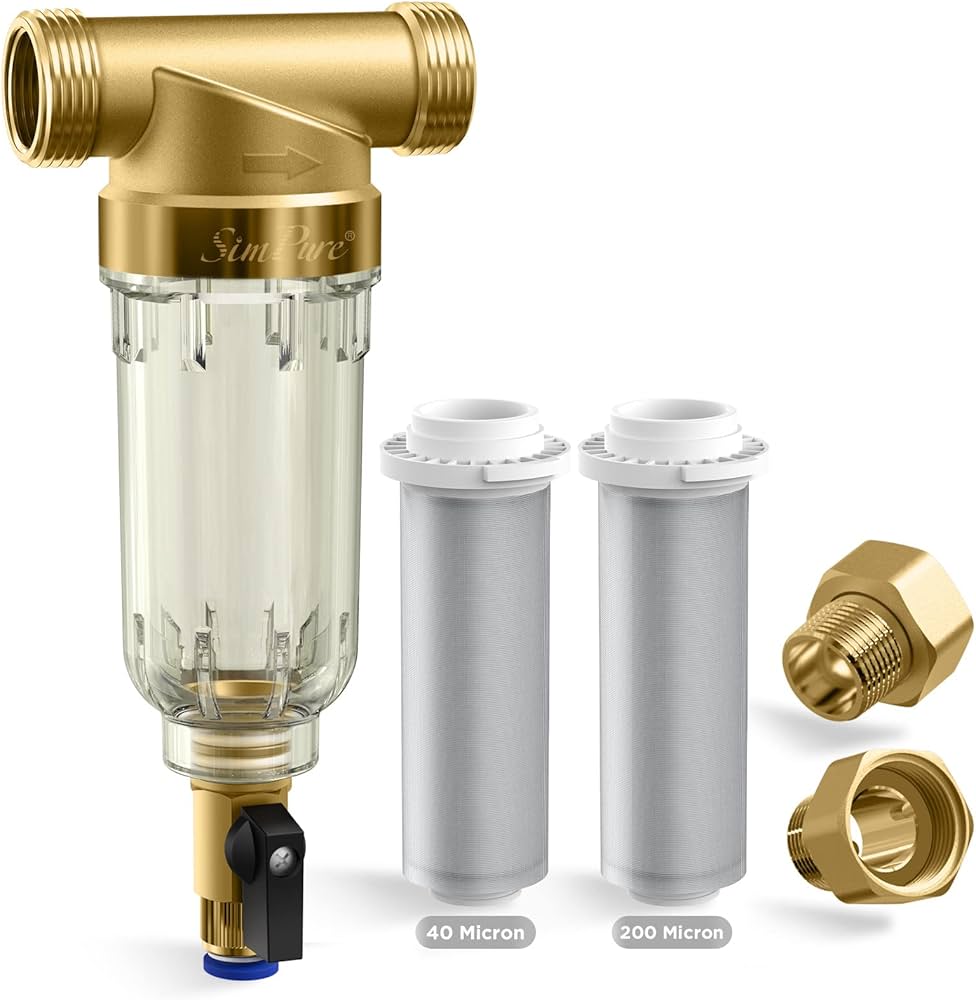
If you’re constantly replacing clogged sediment cartridges, noticing rust stains on your fixtures, or your plumber just recommended a pre-filter — a spin down water filter is almost certainly the answer.
It’s one of the most practical, low-maintenance components you can add to a water system. No replacement cartridges. No media to refresh. Just a flush valve and a clear bowl that shows you exactly what’s been pulled out of your water supply.
What Is a Spin Down Water Filter?
A spin down water filter (or centrifugal sediment filter/sediment separator) is an inline pre-filter that is installed on your primary water supply line. Centrifugal force discards sand, silt, rust particles, and other coarse trash from water before that water ever hits your devices or downstream filters and pipes. Its big distinguishing feature is what it lacks: a market-mediated filter cartridge.
Rather than trapping the particles in media, it spins water around in a clear bowl with gravity and rotational force doing all the work. You periodically open a flush valve at the bottom to purge what’s collected.
Think of it as the first gatekeeper in your water treatment system — catching the heavy stuff so everything downstream lasts longer.
How to Select Micron Rating
Micron rating shows you the particle size that is going to be trapped by filter. It can be one of the most frequently committed errors when buying.
| Micron Rating | Particle Size Captured | Best Application |
| 1,000 microns | Very coarse sand, gravel | Heavy industrial pre-filter |
| 500 microns | Coarse sand | Basic well water protection |
| 200 microns | Fine sand, larger silt | Standard residential well |
| 100 microns | Fine silt, rust flakes | General residential, RO pre-filter |
| 50 microns | Very fine particles | Combo units with screen insert |
For most residential well systems, 100–200 microns is the practical sweet spot. It catches the particles most likely to damage equipment without creating unnecessary flow restriction.
If your water analysis shows predominantly fine clay or very fine silt (under 50 microns), a spin down water filter alone won’t solve your problem. Pair it with a downstream 5-micron cartridge filter — the spin down water filter extends the cartridge’s life significantly by removing the bulk load first.
Sizing for Flow Rate and Pipe Size
An undersized spin down water filter causes chronic low water pressure and defeats the purpose of having it. Match the unit’s rated GPM (gallons per minute) to your household’s peak demand — then size up by about 20%.
| Household Size | Peak Flow Demand | Recommended Filter Rating |
| 1–2 people | 4–6 GPM | ¾” port, 15–20 GPM rated |
| 3–5 people | 8–12 GPM | 1″ port, 20–30 GPM rated |
| 5+ people / large home | 15–25+ GPM | 1″–1½” port, 40+ GPM rated |
| Irrigation systems | Varies by zone | Size by peak zone demand |
Standard residential connections use ¾” or 1″ NPT (National Pipe Taper) fittings. Commercial and agricultural systems step up to 1½”, 2″, or larger. Confirm your pipe size before ordering — adapters work but add connection points and potential leak sites.
Where to Install It in Your Water System
Placement matters. A spin down water filter installed in the wrong location either won’t protect the right equipment or will create maintenance headaches.
For well water systems: Install immediately after the pressure tank, before any other treatment equipment. It protects your water softener, carbon filters and RO membranes from damage of coarse particles.
For municipal water: Install on the main supply line, past the shutoff valve but before any whole-house filtration stages.
Critical rules:
- Mount vertically with the bowl pointing down — gravity assists sediment collection
- Houses trained to withstand freezing (garage, basement utility space)
- Leave adequate access to see the bowl and visit with the flush valve
- Place shutoff valves on both sides for serviceability without draining the entire line
One mistake that’s easy to make: installing the unit backwards. Every spin down water filter has a flow direction arrow on the housing. If you turn it the other way, water flows but not through the centrifugal mechanism — sediment just flows straight out without any separation.
Purchasing Tips What you will need:
PTFE Thread Seal Tape Adjustable Wrench Pipe Cutter Shut-off Valves Bucket or drain hose
- Close up the main water supply and release line pressure by opening a downstream faucet
- Mark and cut the installation point on your supply line — leave room for the housing and fittingsWrap 3–4 layers of PTFE tape clockwise on all male NPT threads
- Connect the inlet and outlet fittings, hand-tight first, then snug with a wrench (1–2 turns past hand-tight — don’t overtighten polypropylene housings)
- Verify the flow direction arrow points in the correct direction before final tightening
- Connect a drain hose or bucket position at the flush valve outlet
- Slowly restore water pressure and check all joints for drips
- Watch the bowl fill — sediment should begin collecting at the bottom within minutes if your water carries any load
The job takes most homeowners 1–3 hours.If you don’t feel comfortable cutting into a main supply line or plumbing around a pressure tank, the installation is usually done in less than an hour by a licensed plumber.
How to Flush and Maintain It
This is where spin down water filters earn their reputation for low maintenance. Flushing takes about 15 seconds.
Flushing procedure:
- Hold a bucket or connect a short drain hose to the flush valve outlet
- Open the ball valve at the base of the bowl
- Let water run until it flows clear (typically 5–15 seconds)
- Close the valve completely
- Done — no tools, no disassembly, no parts
How often? It depends entirely on your sediment load. Check the bowl visually during the first two weeks after installation to calibrate your actual flush frequency.
| Sediment Level | Flush Interval |
| Light (city water, newer pipes) | Monthly |
| Moderate (well water, low turbidity) | Weekly to bi-weekly |
| Heavy (high-sediment well) | Every few days |
| Very heavy (post-storm, flood event) | As needed / daily |
Other than flushing, yearly upkeep is negligible: examine the bowl for breaks or UV yellowing; check the O-ring seal (replace if firm); verify that the flush valve has a full open/close movement and identify calcium scale within the dish when your water is hard.
5 Spin Down Water Filters that are the best
iSpring WSP-50
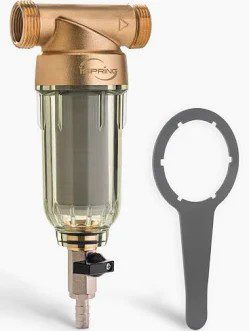
The iSpring WSP-50 is widely regarded as one of the best spin down water filters to use at home. It has a 50-micron reusable stainless steel mesh filter and this filter will eliminate sand, rust, sediment and any other large particles long before they ever reach your primary filtration system. Built-in flush valve so that filter is easy to clean, and it helps lengthen the lifespan of water softeners, carbon filters and home appliances.
iSpring WSP-100
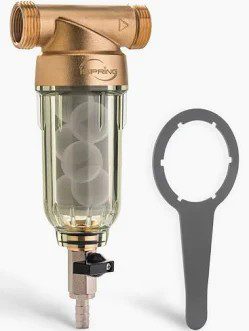
The iSpring WSP-100 is suitable for homes with well water or high sediment levels. Its 100-micron screen catches larger particles while allowing for solid water flow and less repeated maintenance. A key advantage of the reusable design is homeowners can flush out any dirt caught without having to change traditional filter cartridges.
Rusco Sediment Trapper
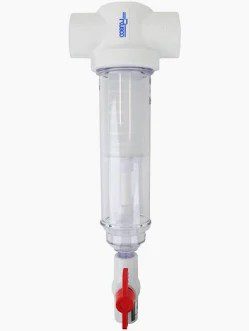
Centrifugal-action design This sediment spin down water filter discharges sediment before reaching the screen Rusco makes a unique sediment water filter that traps sediments with centrifugal action. That is desirable for well water systems commonly carrying sand, dirt and other heavy particles. It is also very durable and easy to clean, which is why it has become a favourite choice by not only home owners but farmers as well.
SimPure SDS-40
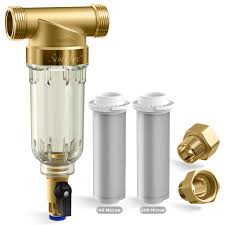
If you are looking for an inexpensive spin down water filter, the SimPure SDS-40 is a great value. It features interchangeable filter screens for users to customize the filtration setup they need. The solid brass housing only needs little maintenance due to the reusable filter element and is designed for heavy load.
Waterdrop WD-RPFK
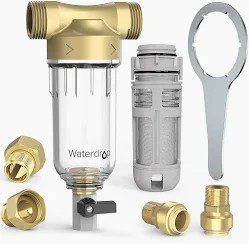
Waterdrop WD-RPFK is a top-end spin down water filter for Sediment that protects whole-house water treatment systems. spin down water filter has a durable body construction, energy-efficient backwash operation and a reusable stainless steel filter screen that allows for low-maintenance cleaning. This purified water aid in sediment leading to much less build-up of debris (sand, silt or rust) delivered within piping and equipment at the treatment plant downstream improves the overall system.
Spin Down Water Filter vs. Other Sediment Filters
| Filter Type | Micron Range | Maintenance | Ongoing Cost | Best Use |
| Spin Down | 50–1,000 | Flush valve only | Near zero | Coarse pre-filtration |
| Cartridge (whole house) | 1–50 | Replace cartridge | $20–$80/cycle | Fine sediment |
| Backwash filter | 5–100 | Automated backwash | Low | High-volume continuous |
| Y-Strainer | 200–800 | Manual disassembly | Low | Light-duty irrigation |
| Sand media tank | 5–20 | Annual media change | Low-medium | Irrigation, agricultural |
The most effective approach for well water is using a spin down water filter and a downstream cartridge filter together. The spin down water filter removes the bulk coarse load, which extends cartridge life from weeks to several months. You get both coarse and fine filtration coverage at a reasonable combined cost.
Troubleshooting Common Problems
| Symptom | Likely Cause | Fix |
| No sediment collecting in bowl | Unit installed backwards | Check flow arrow, reinstall correctly |
| Noticeable pressure drop | Unit undersized for flow demand | Upgrade to higher GPM model |
| Sediment passing through to system | Micron rating too coarse | Add fine cartridge downstream |
| Bowl leaking at housing joint | Failed O-ring or cracked bowl | Replace O-ring or bowl assembly |
| Flush valve dripping when closed | Worn valve seat | Replace flush valve |
| Filter installed in freezing area | Bowl cracked from ice expansion | Relocate or insulate; use heat tape |
Conclusion
A spin down water filter addresses a specific, common issue — coarse sediment in a water source that damages equipment, clogs downstream filters and shortens appliance life. This is by no means a full-fledged water treatment system — spin down water filter will not remove bacteria, dissolved minerals, chlorine, or heavy metals. But as the first stage in a whole-house filtration train, it does its job reliably, with almost no ongoing cost, and with zero cartridge replacements.
For well water users especially, it’s one of the highest-value additions you can make to your system. Pair it with a fine-micron cartridge filter downstream, size it correctly for your peak flow demand, install it post-pressure tank, and flush it on schedule. That combination handles the vast majority of sediment problems most homeowners encounter.
If you’re still unsure whether your water warrants one, start with a basic turbidity and iron test. The results will tell you exactly what you’re dealing with — and from there, the right solution is straightforward.
These information are gathered from different surveys, medical tests and tech giants like google, wikipedia and more. Our top priority is to provide you valuable information.
For More Details About Different Water Filters Click Here