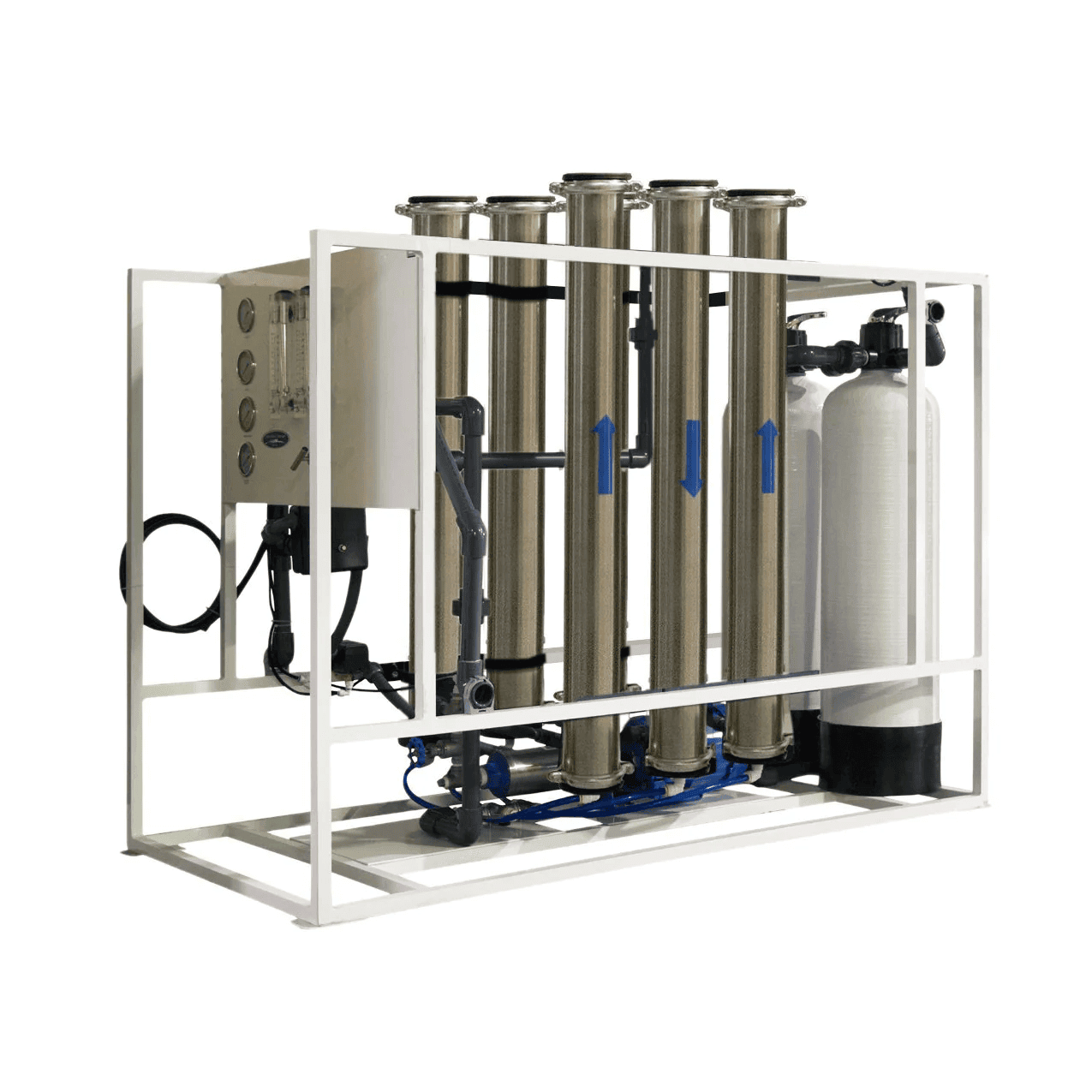
Water quality in any business setting, be it restaurants, hotels, clinics or manufacturing operations is more than an optional extra; it has the power to determine equipment lifespan, product consistency and compliance status. commercial reverse osmosis water systems offer one solution; but many owners struggle with knowing if and which size system they actually require as part of a solution plan.
This guide takes an in-depth approach to commercial reverse osmosis water systems, discussing everything from what they are to their uses, costs and selection without overpaying or succumbing to more capacity than necessary.
What Is a Commercial Reverse Osmosis Water System?
A commercial reverse osmosis water system is an industrial grade water filtration setup designed specifically to filter feed water using semipermeable membranes under high pressure, filtering out up to 99.997% of contaminants such as solids, bacteria and contaminants at high volumes in high volume feed water streams. These units are built for continuous business use rather than occasional home usage.
Commercial reverse osmosis water systems differ significantly from residential units not just by size but engineering as well. Commercial units feature continuous-duty pumps, larger pressure vessels and automated controls which produce between 500 to over 100,000 GPD; compare this figure with typical home units which produce between 50-100 GPD.
You might hear of this technology referred to as commercial RO, industrial reverse osmosis (RO) or water filtration systems – each term describes its core process with different capacity tiers.
Who Actually Needs One
Not every business requires industrial-grade filtration; commercial RO systems offer cost-effective options in these circumstances.
| Business Type | Typical Use |
| Restaurants & cafes | Drinking water, ice machines, espresso equipment |
| Hotels | Guest Water, laundry facilities, kitchens and swimming pools. |
| Hospitals & clinics | Dialysis water, sterilized, lab-grade water |
| Food & beverage manufacturers | Process water for bottling, brewing and dairy use |
| Laboratories | Reagent-grade, analytical water |
| Car washes | Rinse water to remove spots. |
| Manufacturers (electronics, pharma) | Ultrapure process water |
A single-family home or a small office with low usage and decent municipal water typically doesn’t need this — a point-of-use filter is enough. The line usually gets crossed once daily demand exceeds roughly 100–200 gallons, source water TDS (total dissolved solids) tops 500 ppm, or you’re running equipment that’s sensitive to scale.
How Commercial Reverse Osmosis Water System Actually Works
Commercial reverse osmosis water systems employ an elaborate process that involves multiple steps: water is first filtered prior to being compressed and then forced by a semi-permeable barrier which eliminates contaminants by pure water.
In the real world, this process is broken down in seven stages.
- Prefiltration eliminates particulate and sedimentary matter, whereas carbon filtration can help get rid of chloramine and chlorine that may affect membrane efficiency. If necessary softening (if necessary) assists in lowering the hardness of magnesium and calcium in order to reduce scaling problems.
- Carbon filtration eliminates chlorine and chloramine which can damage membranes. Water softening lowers the hardness of magnesium and calcium in order to prevent the possibility of scaling.
- Pressurization — High pressure pumps typically generate 100-1100psi depending on system size to force water against a membrane.
- Membrane separation capabilities, which allows water molecules to pass while filtering out most salts, bacteria and contaminants from passing.
- Permeate collection stores the purified water or sends it directly to equipment.
- Reject discharge drains the leftover concentrated water — some higher-efficiency systems recycle part of this stream.
An optional final stage adds UV disinfection or remineralization, which restores some of the minerals RO removes and improves taste.
Types of Commercial Reverse Osmosis Water Systems
Commercial reverse osmosis water systems generally fall into a few configurations, and picking the right one depends on how many points in your facility need treated water.
A quick comparison of trade-offs:
| Type | Pros | Cons |
| POU | Lower cost, simple install | Won’t cover whole-building demand |
| POE / whole-building | Consistent quality everywhere | Higher upfront cost, more plumbing work |
| Skid-mounted industrial | Modular, scalable | Needs dedicated space and a trained operator |
| Mobile RO | Flexible, deployable anywhere | Higher cost per gallon |
3 Best Commercial Reverse Osmosis Water Systems
1. iSpring CRO1000
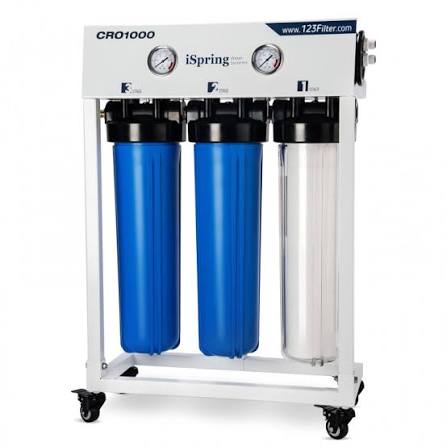
The iSpring CRO1000 is the top overall pick for higher-volume commercial use, delivering an impressive 1,000 GPD output in a build that’s designed to be mobile and easy to relocate between sites or stations. It’s a solid choice for businesses that need real throughput without committing to a fixed industrial installation — think busy cafes, small hotels, or multi-station setups where the system might need to move.
2. iSpring RCS5T
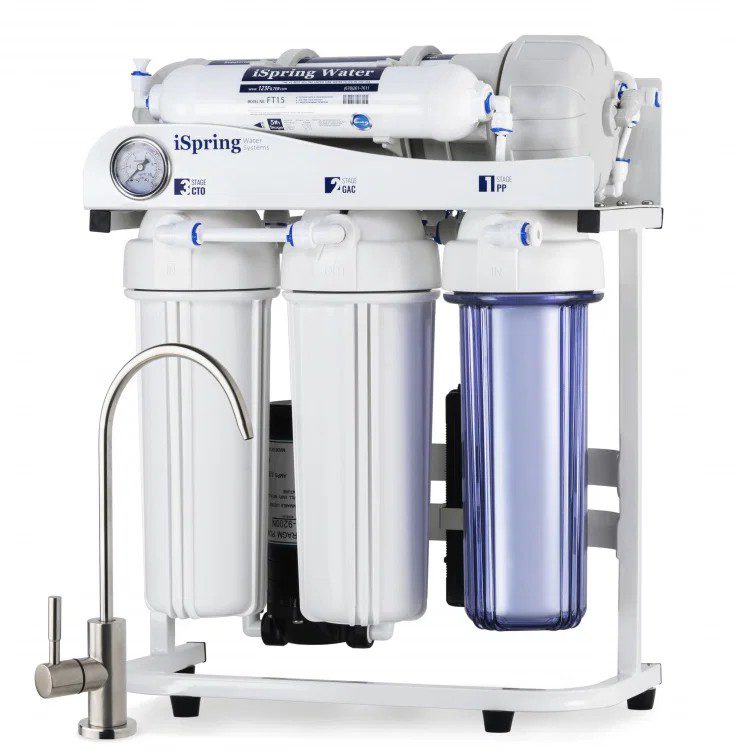
The iSpring RCS5T is the budget-friendly option that still delivers professional-level filtration well beyond residential units, offering 500 GPD capacity with an efficient 1.5:1 pure-to-drain ratio and a tankless design. It’s a good fit for smaller businesses that want commercial-grade reliability without paying for capacity they won’t use — just keep an eye on peak water demand to make sure it doesn’t get pushed past its limit.
3. Oceanic 800 GPD RO/DI
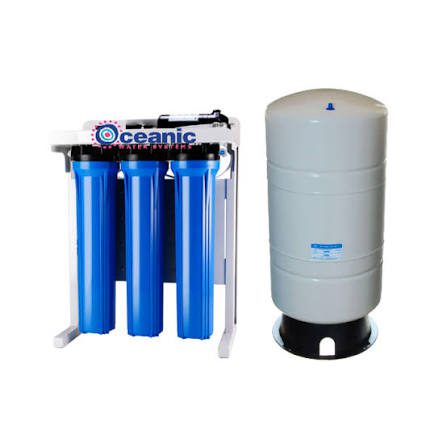
The Oceanic 800 GPD RO/DI system was specifically designed to fulfill an entirely different task than simply optimizing volume: rather than seeking maximum capacity, its unique combination of reverse osmosis with deionization achieves zero TDS levels for ultrapure water rather than simply clean. As a result, its use makes this ideal choice for labs, aquariums, precision manufacturing environments where even trace dissolved solids cannot be tolerated, rather than general drinking-water or kitchen use.
What a Commercial Reverse Osmosis Water System Actually Costs
Commercial reverse osmosis water system Costs vary significantly according to capacity and local water chemistry; so take this as general guidelines rather than guaranteed quotes.
| Cost Category | Typical Range |
| Small commercial RO (500–2,500 GPD) equipment | $1,500 – $6,000 |
| Mid-size commercial RO (5,000–20,000 GPD) equipment | $8,000 – $30,000 |
| Large industrial RO (25,000+ GPD) equipment | $40,000 – $250,000+ |
| Professional installation | $500 – $10,000+ |
| Annual maintenance & membrane replacement | $500 – $5,000+ |
Regional water chemistry is often the biggest cost driver — more than the brand or GPD rating. Areas with harder groundwater usually need extra pretreatment and softening, which adds to the price. Before finalizing pricing with installers near you, always request an on-site water test and obtain an estimated total cost of ownership figure that includes equipment purchase/installation cost as well as 3-4 years of maintenance fees – not simply sticker prices on units!
How to Choose the Right System
Before purchasing commercial reverse osmosis water system, here is an essential checklist you should review when making your decision:
- Strictly test the source water: TDS levels, hardness levels and chlorine content all affect how big or pretreated a tank must be for proper functionality.
- Calculate peak demand accurately instead of basing it off an average day’s demand.
- Verify whether your industry requires NSF/ANSI 58 or 61 certified components.
- Decide how much automation you want — manual monitoring versus automated controls with remote alerts.
- Check that you have the floor space, drain access, and electrical capacity the system needs.
- Compare recovery rates across quotes — higher recovery costs more upfront but saves on water bills long-term.
- Prioritize installer availability for ongoing service over the lowest equipment price alone.
Maintenance and Common Mistakes
Pre-filters made up of sediment and carbon should generally be replaced every three to six months depending on usage; while membranes often last two to five years with proper pretreatment; heavy scaling could significantly shorten this lifespan. A decrease in permeate flow or an increase in reject-water TDS typically indicate fouling within an over time membrane system.
Most often made errors:
- Skipping pretreatment to save money upfront, which shortens membrane life dramatically
- Undersizing the storage tank, forcing the pump to run constantly and wear out early
- Overlooking reject-water drain requirements during installation
- Buying before testing source water, leading to a mismatched system
- Waiting until water quality visibly drops before replacing membranes
In healthcare and food-service settings especially, deferred maintenance isn’t just a cost problem — it’s a compliance and safety one. Following the manufacturer’s service schedule matters more in regulated environments than almost anywhere else.
Standards and Certifications Worth Knowing
A few standards come up repeatedly in commercial RO procurement, and it’s worth understanding what they actually cover:
- NSF/ANSI 58 governs reverse osmosis drinking water treatment systems specifically.
- NSF/ANSI 61 covers health effects for drinking water system components generally.
- FDA requirements apply where water touches food or beverage production.
- EPA Safe Drinking Water Act establishes standards for municipal water quality across America.
Local health department codes vary by state and city; in many instances these include regulations pertaining to ice machines, food prep water and dialysis fluid specifically.
FAQs About Commercial Reverse Osmosis Water System
Q: How Much Does a Commercial reverse osmosis water system Cost?
Costs of commercial reverse osmosis water systems could range from around $1500 in smaller units that are point-of-use to $250,000 for industrial units depending on the capacity, the quality of the water and the difficulty of installing.
Q: How long should an RO membrane last commercially?
Most commercial membranes last 2–5 years with proper pretreatment. Poor pretreatment or heavy scaling can shorten that significantly.
Q: How much water does a commercial reverse osmosis water system waste?
Standard systems typically use 25–50% of feed water as reject water. High-efficiency commercial systems can push recovery rates above 80%.
Q: Do commercial reverse osmosis water systems remove minerals the body needs?
Yes — RO removes most dissolved minerals along with contaminants. Many commercial systems add a remineralization stage afterward to restore taste and mineral content.
Conclusion
A commercial reverse osmosis water system is one of those investments that pays for itself quietly — in equipment that lasts longer, products that stay consistent, and compliance boxes that stay checked. The businesses that get the most out of one are the ones that test their water first, size to actual peak demand, and price the total cost of ownership rather than just the equipment sticker price.
If you’re at the stage of comparing options, start with a water test, get quotes that break out equipment, installation, and multi-year maintenance separately, and pick an installer who’ll still be around when it’s time to swap a membrane — not just whoever quoted the lowest number.
These information are gathered from different surveys, medical tests and tech giants like google, wikipedia and more. Our top priority is to provide you valuable information.
For More Details About Different Water Filters Click Here